
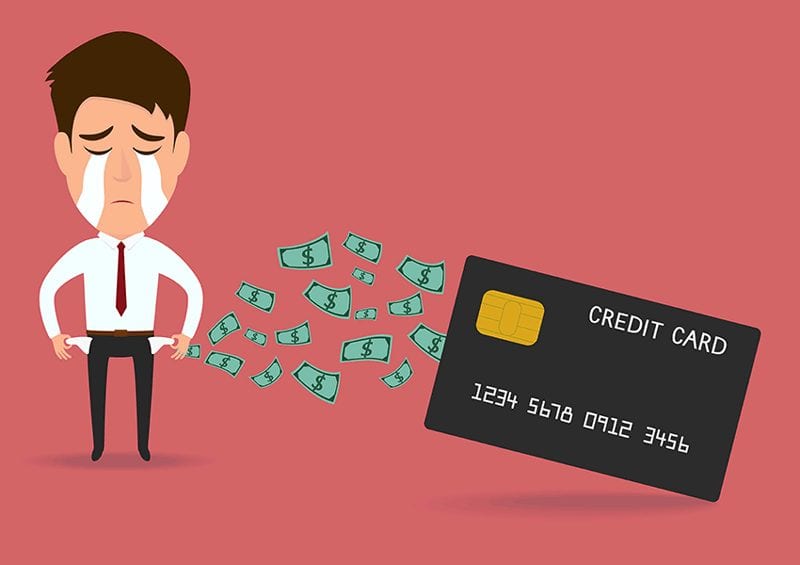
You have never missed a payment. Your credit score looks “good.” You are doing what you were told to do.
So why does it still feel like you are underwater.
Because credit card companies do not reward perfect behavior with freedom. They reward it with more time in the system.
Perfect payment history is the cleanest signal that you will keep paying interest.
The uncomfortable truth
Credit card companies make real money when you carry a balance and pay interest for a long time. The minimum payment is engineered to do one thing: keep you paying, keep you “current,” keep you trapped.
If you are paying on time but your balance is not dropping fast, you are not winning. You are renting your own life back from a credit card company at 22 percent to 29 percent APR.
That is not financial responsibility. That is a subscription.
How the trap works (in plain English)
When you make only the minimum payment, most of your payment goes to interest first. What is left goes to principal, which is the only part that actually reduces your balance.
So month after month, you do the “right” thing, but the balance barely moves.
You stay compliant. They stay profitable.
Example: the math that nobody shows you
Let’s say you have a $15,000 credit card balance at 24 percent APR.
Month one interest is roughly:
$15,000 × 0.24 ÷ 12 = about $300
If your minimum payment is around 2 percent of the balance, that is roughly $300.
Meaning: your minimum payment can be almost all interest.
So you pay. Your balance barely drops. You feel responsible. You stay stuck.
Now imagine doing that for years.
Why “on time” is not the same as “making progress”
Payment history is a credit scoring factor. It is not a wealth building factor.
The system is not built to help you get ahead. It is built to measure whether you are a reliable payer.
Reliable payer means:
- You keep the account open.
- You keep paying interest.
- You stay eligible for more credit.
It is a treadmill. Not a ladder.
The real goal is not a perfect score
A credit score is not your financial report card. It is a risk score used to price debt.
A high score can still mean:
- High utilization and constant interest
- No cash cushion
- No investing
- No real margin
You can be “winning” at credit and losing at life.
The real goal is cash flow, stability, and a path to zero high interest revolving debt.
The three paths out (and who each is for)
There are three common routes people take. The right one depends on your numbers, your income stability, and your tolerance for tradeoffs.
Path 1: Aggressive payoff (snowball or avalanche)
Best for: people with enough cash flow to attack principal fast.
What it requires:
- A real budget
- Cutting spend temporarily
- Paying far above the minimum
What you get:
Less risk, less complexity, and a clean win.
Path 2: Consolidation (only if the rate is truly lower)
Best for: people who can qualify for a materially lower rate, and who will not re run balances back up.
Consolidation works when:
- The interest rate drop is meaningful
- The payment fits your cash flow
- You close the behavior loop that created the balance
Consolidation fails when:
- You get a loan, then use the cards again
- The new payment is too tight
- The “lower rate” is not actually low
Path 3: Settlement (a reset, not a hack)
Best for: people who cannot realistically pay the full balance, and need a structured exit.
Settlement is a negotiation process. It can reduce the principal you owe, but it comes with real tradeoffs.
It is not for everyone, and it is not “free money.”
Important (read this): Debt settlement can involve collections activity, creditor pressure, and in some cases legal action depending on creditor behavior and your situation. Forgiven debt may be taxable in some scenarios. This is not legal or tax advice. You should evaluate options based on your full financial picture.
If you are already at the edge, settlement can be the fastest route back to breathing room. If you are not at the edge, it may be an unnecessary hit.
The decision rule (use this to stop guessing)
Ask yourself one question:
If I keep doing what I am doing now, will I be out of credit card debt within 24 months.
If the answer is yes, you probably need an aggressive payoff plan and tighter structure.
If the answer is no, you need a different strategy. Not a stronger willpower speech.
Because time is the real cost. Every month you stay in high interest debt is money you never get back.
Quick self check (30 seconds)
If two or more of these are true, you are in the trap:
- You pay on time but the balance barely drops
- You are paying hundreds per month and still feel stuck
- You use one card to pay another bill
- You have no emergency cushion
- You are stressed about the next unexpected expense
FAQ
Is it bad to pay on time
No. Paying on time is basic hygiene. The trap is thinking it is enough.
Why does the minimum payment barely work
Because it is designed to keep the account current while maximizing interest collected over time.
Should I close my credit cards
Sometimes. It depends on your plan and your behavior. Closing without a strategy often backfires. Keeping them open without behavior change often backfires too.
What if I am scared of my credit score dropping
A score drop is a short term cost. Staying in high interest debt for years is a long term tax on your life. The right move depends on your timeline and options.